
Nowcasting with AI for African Rainfall (NAIAR)
The Nowcasting with AI for African Rainfall (NAIAR) project has been awarded £1 million of funding by UK Research and Innovation (UKRI) through the Natural Environment Research Council (NERC). NAIAR is a collaboration between the University of Leeds, where 3 different schools are contributing (Profs Doug Parker and John Marsham, Earth and Environment; Steve Tobias, Mathematics; and David Hogg, Computing), and UKCEH (Seonaid Anderson and Chris Taylor; Chris is also a Visiting Professor at Leeds).
The NAIAR project is creating new digital solutions to create 0 to 6 hour predictions – “nowcasting” – for tropical storms, using satellite data.
The methods are being developed and rolled-out for Africa, where people urgently need information about storm hazards. New methods will be released in real time on existing online platforms such as the SWIFT Catalogue and the CEH Nowcasting Portal and the FASTA smartphone app being supported by the National Centre for Atmospheric Science (NCAS) at Leeds, and the UK Centre for Ecology and Hydrology (UKCEH). In this way the results of the research will be used to deliver information on storm hazards to users in Africa within minutes.
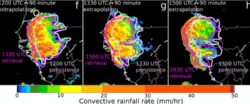
Example of existing satellite nowcasting product for Senegal, showing 90-minute predictions (colours) and an outline of the observed storm at the same time (pink contour). Images like these are being generated in real time on the NCAS African nowcasting site (https://science.ncas.ac.uk/swift/) and are used by forecasters in Africa.
While existing satellite nowcasting methods have some skill, they also have major shortcomings. They work by extrapolating observed patterns forward in time, but are not constrained to obey the laws of physics, and unphysical predictions commonly occur. The most challenging problem in storm nowcasting is to predict the initiation and subsequent development of new storms in future: there is no accepted way to do this, and our considerable knowledge of the physics of initiation is not being exploited. It takes about 30 minutes to generate these nowcasts, and when their accuracy is degrading after an hour or two, their use becomes limited. The NAIAR project aims to create useful 6-hour nowcasts.
Nowcasting is an obvious application where new data-science methods, in particular AI, have the potential to make a massive impact. NAIAR will conduct fundamental research to understand and improve the performance of these data-driven solutions, on the basis of the underlying physics and fluid dynamics of storms. For instance, existing methods can extrapolate an image of a storm forward in time using AI to predict its future movement or growth, but the result may grow and be distorted in shape in a way which is incompatible with the laws of physics. These unrealistic predictions are obvious to an experienced forecaster but ordinary users of the data will be vulnerable to the consequences of inaccurate nowcasts. When nowcasts are used to predict hazards such as floods, unphysical solutions could lead to bad decisions.
NAIAR aims to combine machine-learning, theoretical fluid dynamics, operational prediction and meteorology, to create innovative approaches to nowcasting of tropical storms. The project will develop ML methods which are fast, and which obey physical laws, like the weather prediction models. Recent advances in physical understanding, and the new data offered by MTG, will be used to create statistical nowcasts of storm initiation and its subsequent evolution. The project will apply these methods through NCAS and UKCEH’s existing web-based and mobile-phone communication portals delivering information to Africa, and support colleagues in Africa to exploit the methods locally.