
WISER-EWSA project | March 2023 - June 2025
Bringing Early Warnings of Severe Weather to the people of Southern Africa

From March 2023 – June 2025, the WISER EWSA team of meteorologists, academics, economists, and user engagement specialists from South Africa, Zambia, Mozambique and the UK worked with disaster risk management agencies and non-governmental organisations, focusing on women and people with disabilities to reduce disaster risk through the co-production of new weather information services and early warnings. WISER EWSA co-produced short-term weather updates around storms with socially disadvantaged urban populations. A collaboration between the National Centre for Atmospheric Science and the University of Leeds in partnership with the South African Weather Service, Kulima Integrated Development Solutions, Zambia Meteorological Department, Mozambique National Meteorology Institute (INAM), the UK Met Office, UK Centre for Ecology and Hydrology, Finnish Meteorological Institute, Tyrsky Consulting, EUMETSAT and the World Meteorological Organisation. Adding to a growing range of weather and climate information services, Nowcasting technology has recently been applied to early warning in other parts of Africa and beyond but this was the first project to do this in Southern Africa. Working directly with communities in Lusaka (Zambia), Boane, Maputo (Mozambique) and Katlehong (South Africa). The project undertook two forecasting testbeds, Testbed 1 took place in Lusaka, Zambia from 29 January until 9 February 2024, with Testbed 2 taking place over the entirety of the 2024-25 rainy season (October 2024 - April 2025) with 10 days of intensive Nowcasting and Forecasting in Lusaka, Zambia from 30 January until 7 February 2025 and in Maputo, Mozambique from 24 to 28 March 2025
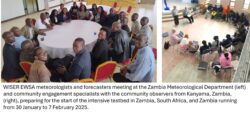
Particular outputs of this project included:
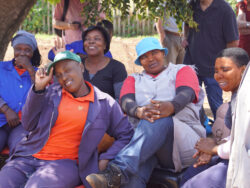
Women involved in a small-scale farming enterprise, vulnerable to extreme weather
-
- Better ability of forecasters to use nowcasting technology to track storms
- Stronger links between forecasters and members of the public, including people living in cities
- Early warnings that are understandable and actionable to people living in cities, including disadvantaged groups such as women and people with disabilities.
- Learning how to sustain and scale up these alerts, so that they cover other cities and other parts of the three countries.
Our approach is one of partnership and engagement, which is essential to ensure that the technology translates into useful information for people on the ground. We commit to regular communication and need your feedback to improve the process and enable us to record what work Advancements have already been made with Nowcasting technology and knowledge. Awareness of, and demand for, weather information has increased in Mozambique, South Africa and Zambia.
For more information about this project please email: [email protected]
Resources Publications