
PANCAST
PANCAST in Madagascar: An Exploratory Visit on AI-Driven Satellite Nowcasting and Outreach
PANCAST (Pan-African Core Nowcasting with Core-Aware Spatio-Temporal Transformers) is an object-based deep learning system for predicting convective core occurrence across Africa from geostationary satellite observations. Using convective cores detected from Meteosat Second Generation (MSG) infrared imagery, it produces gridded probabilistic nowcasts up to two hours ahead at 30-minute intervals. PANCAST is now live at https://africa-hydrology.ceh.ac.uk/nowcasting.
The system was developed by Mendrika Rakotomanga, a postgraduate researcher in the School of Mathematics, supervised by Prof Douglas Parker, Dr Nadhir Ben Rached, Dr Cornelia Klein, and Dr Seonaid Anderson (UK Centre for Ecology and Hydrology), with support from HEIF Strengthening and Maturing Impact Case funding from the University of Leeds. PANCAST was also recognised with a Highly Commended award in the Community Impact and Innovation category at the 2026 Leeds EPS Partnership Awards.
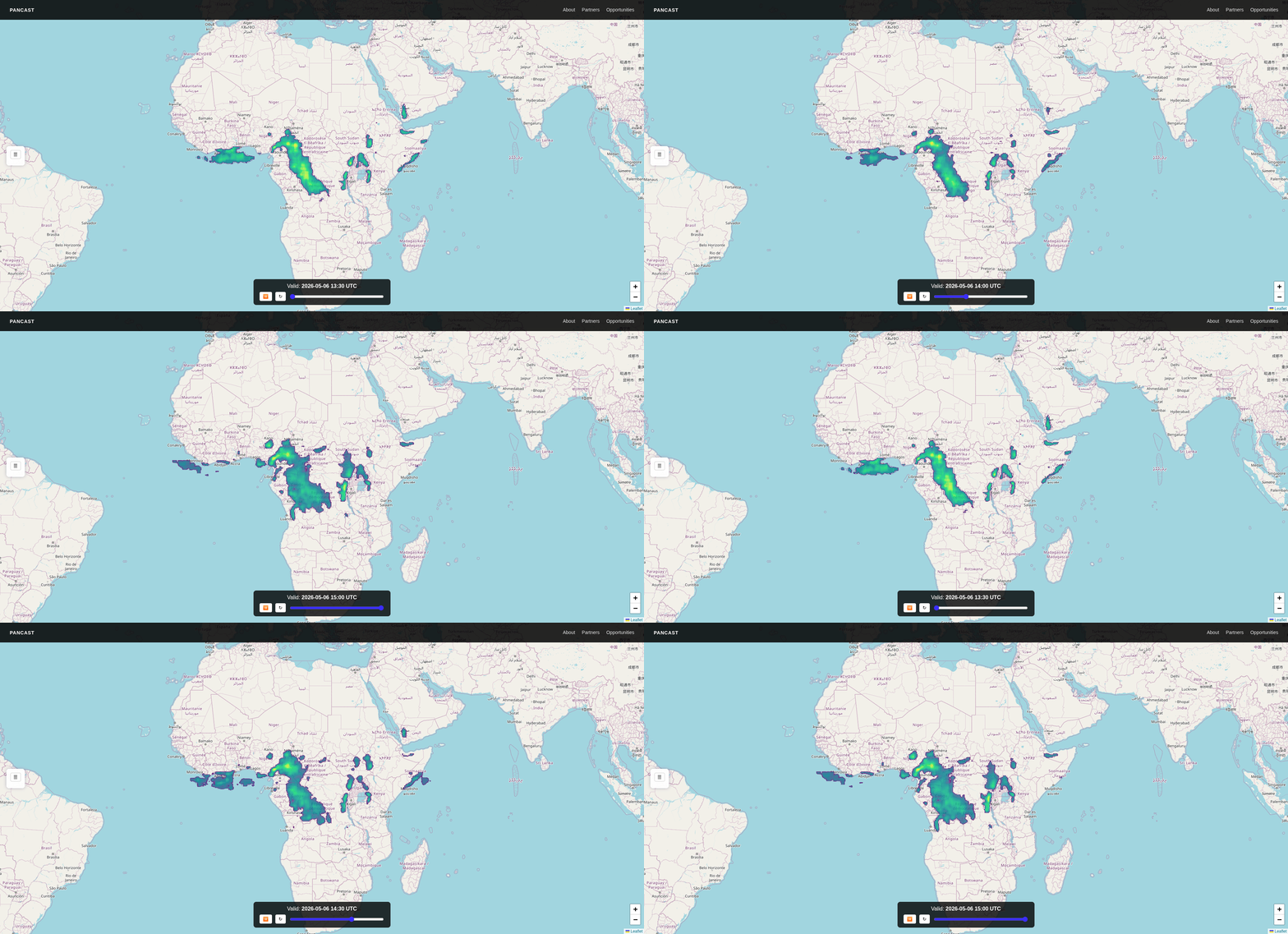
PANCAST Live showing the probability of convective core occurrence over Africa in near-real-time.
To promote PANCAST and improve its local relevance, an exploratory visit to Madagascar was carried out to engage with several institutions and explore opportunities for collaboration. At the Direction Générale de la Météorologie (DGM) Madagascar, PANCAST was demonstrated as a tool for near-real-time convective storm nowcasting alongside FASTA and the UKCEH nowcasting portal, providing a broader context of ongoing developments in AI-based and satellite-driven forecasting. Discussions focused on the use and evaluation of these systems for early warning and their potential to support meteorological operations in the region. At ENS Antananarivo, discussions with the Centre de Recherche en Éducation Environnementale (CREE) focused on early warning dissemination in Madagascar and how these approaches could be integrated into PANCAST. The visit also included the laboratoire Dynamique de l’Atmosphère, du Climat, et des Océans at the University of Antananarivo, where discussions covered convective storm satellite datasets, AI-based downscaling, and potential collaboration.
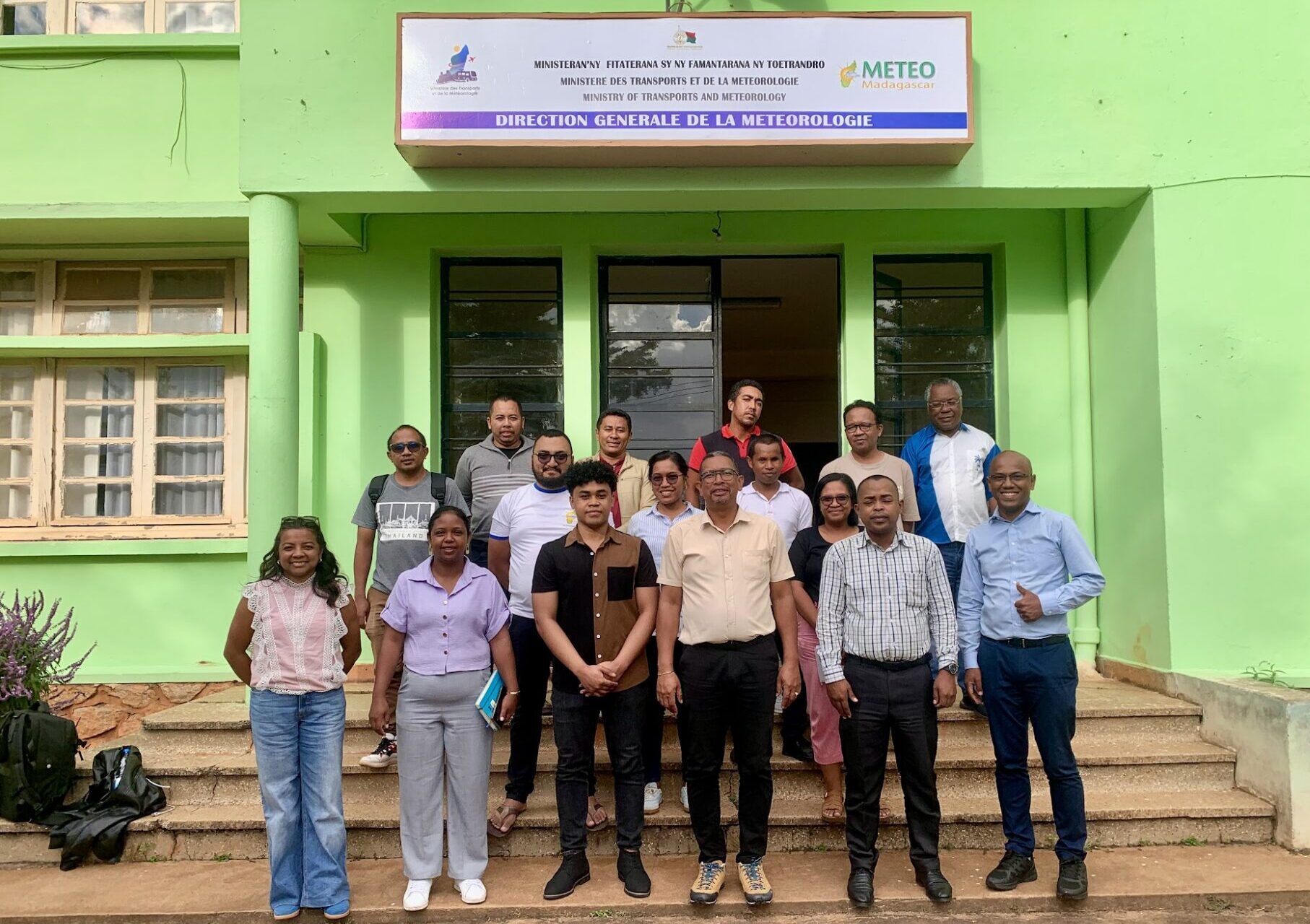
PANCAST visit to the Direction Générale de la Météorologie, Madagascar
PANCAST was also used as a central element of outreach activities from middle school to university level. It provided a concrete example of how AI can be applied to real-world weather challenges, helping make these concepts more accessible and encouraging interest in STEM studies. In total, these sessions reached over 500 students through interactive talks, live demonstrations, and panel discussions.

PANCAST outreach and engagement activities in Madagascar, including talks, live demonstrations, and panel discussions on AI, remote sensing, weather forecasting, and STEM studies.
Following this visit, the next steps will focus on improving the PANCAST user interface and user experience to better support operational use, as well as establishing more formal collaborations with DGM, CREE, and the University of Antananarivo.
We would like to thank Sciences Physiques et Avenir NGO, Platoni Academy, and Toromarika sy Paika School, as well as volunteers from the AIMS, DARA, and AEPCENS alumni networks, for their support in organising and delivering these activities