
Remote Sensing and Machine Learning for UK winter wheat prediction
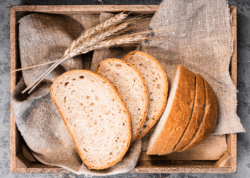 Increasing UK Dietary Fibre - The Case for the Great White British Loaf
"Increasing UK Dietary Fibre - The Case for the Great White British Loaf" is a collaborative project by UK researchers and industry partners. It seeks to bypass consumer resistance to wholemeal bread by delivering increased fibre through a product people already prefer: the traditional white loaf.
The initiative, a collaboration between the University of Leeds, University of Reading, and Rothamsted Research, focuses on using newly developed, UK-grown, fibre-enhanced wheat to produce high-fibre white flour and bread without compromising quality or increasing costs. The project seeks to address the challenge of achieving fibre fortification while maintaining consumer acceptance and improving public health outcomes, particularly reducing risks for bowel cancer and chronic diseases.
A new approach to predict winter wheat yields
The project integrates sciences across disciplines to build an evidence base towards transformations in the UK wheat agri-food chain. At Leeds, our work has focused on developing a new approach to predict winter wheat yields using biomass calculated from Normalized Difference Vegetation Index (NDVI) data: the General Large Area Model for annual crops using Satellite remote sensing data (GLAM-Sat). A gridded implementation of this modelling framework was developed to predict winter wheat yields across the UK, with a logistic curve used to finish the growing season at different lead times.
GLAM-Sat seasonal forecasts: We are finalising our new wheat yield seasonal forecasting model. This uses machine learning to predict crop development, and remotely sensed vegetation index data to assess seasonal biomass and yield. The model has the potential to inform management decisions, such as harvesting dates and whether to apply fertiliser during key times of the growing season, with implications for milling vs. feed wheat.
GLAM-Sat shows high skill in reproducing interannual variability of historical yield data when driven by NDVI data for the whole growing season. Skill gradually reduces as lead time increases, although predictive ability is still demonstrated as early as March.
GLAM-Sat has potential for enhancing management of wheat in two key areas: i). Operational input management: guiding how much and where to apply costly inputs such as nitrogen to boost yields, and ii). post-harvest logistics and commercial planning: helping to prepare for harvest timing and volume for forward contracting and storage optimisation.
2050 UK crop yield information: We have also produced mid-century crop yield projections for a range of major UK arable crops using an existing crop-climate model ensemble and information from the climate impacts literature.
This project follows on from a 2020 discovery project led by scientists led by Rothamsted Research and the John Innes Centre that identified parts of the genome that control fibre content of white flour, raising hope that a high fibre white loaf could be possible and in shops within five years.